Possess to Finish and Transition: Turning Possession into Goals
A high-intensity drill that connects possession play with finishing and quick transitions. Learn how to set it up, run it, and coach the key moments.
Most possession drills stop at the pass. This one doesn’t.
Possess to Finish and Transition connects two things coaches spend a lot of time working on separately, keeping the ball and putting it in the net, and trains them together in the same exercise. Players learn to combine in tight spaces, time their runs, and finish with purpose. And the moment possession changes hands, they flip the switch instantly.
It’s a high-intensity drill that replicates real match moments. Here’s how to run it.
How do you set up the Possess to Finish drill?
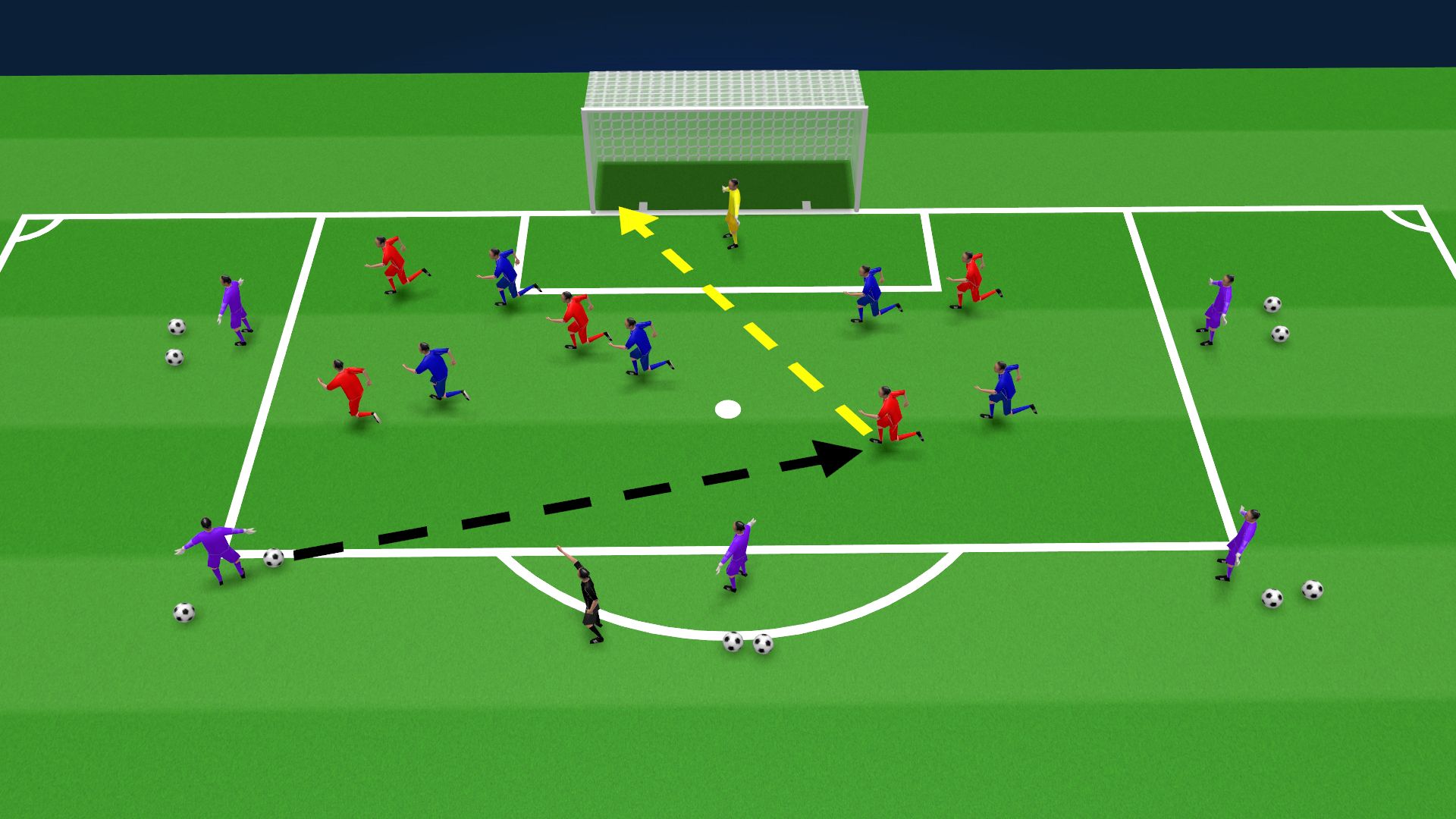
Set the activity inside the 18-yard box with three teams: two competing inside the grid and one acting as bounce players around the outside.
- Two teams compete inside the grid, one in possession, one defending
- One team acts as bounce players positioned around the outside of the box
Bounce players support whichever team currently has the ball. They’re not passive. They’re tools. Their job is to help the possession team create scoring opportunities through quick combinations.
How does the drill actually work?
To score, the team in possession must complete a three-step sequence: play out to a bounce player, receive the return, then finish on goal.
- Play into a bounce player outside the grid
- Receive the return pass back into the box
- Finish on goal
That sequence forces combination play and timing. Players can’t just run at goal. They have to connect through the bounce player first, which mirrors how real attacking moves are constructed.
When the defending team wins the ball: they become the attackers. They can immediately play out to a bounce player, receive the return, and go to goal. The faster they transition, the better the chance.
Rounds are 2 minutes or first to 2 goals, short enough that intensity stays high and every decision matters.
What are the key rules in this drill?
A few constraints shape how the drill plays out and keep the pace high.
- Players do not have to shoot first time after receiving from a bounce player. They have a touch if they need it
- Bounce players cannot shoot. They set up the chance, they don’t take it
- Bounce players have a 3-second limit on the ball. No holding, move it quickly
These rules keep the pace up and force players to think ahead. If you know the bounce player has 3 seconds, you need to be moving before the ball arrives.
How do you run this drill well?
Run it well by reminding players what they’re actually training: how chances get created and what to do the moment the ball changes hands. The drill works best when players understand it’s not a shooting drill.
Movement creates opportunities. Players standing still are easy to defend. Quick, sharp movements open passing lanes and create better angles to use the bounce players. If the inside players aren’t moving, the drill breaks down.
Use bounce players with purpose. A pass to a bounce player should set something up, a return ball timed so the receiver is already in a shooting position. Bounce players aren’t just outlets to relieve pressure. They’re part of the combination.
Play quickly. The 3-second rule on bounce players exists to force fast decision-making across the whole group. Teams that think ahead, already moving before the ball arrives, will consistently create better chances than teams that react after the pass.
Know when to finish. Players should shoot when it’s on. If the chance is there, take it. If it’s not, keep moving the ball. The drill rewards decisive finishing, not forced shots.
Transition is the whole point. The most important moments in this drill aren’t the goals. They’re the two or three seconds right after possession changes. Teams that react quickly when they win the ball create immediate danger. Teams that react quickly when they lose it avoid giving up easy goals. Both habits carry directly into match situations.
What should coaches watch for during this drill?
Watch four specific things to know whether the drill is working as intended.
- Are players moving constantly inside the box, or waiting for the ball to come to them?
- Are passes into bounce players timed and purposeful, or just clearances under pressure?
- Is the team transitioning immediately when possession changes, or taking a moment to process it?
- Are players making good decisions about when to shoot vs. when to keep the ball?
If the drill feels chaotic, slow it down and walk through the three-step scoring sequence until the pattern clicks. Once players understand the structure, the pace takes care of itself.
Why does this drill actually work?
It works because it replicates something that happens dozens of times in every match: a team trying to break down a compact defense in a tight space, combine quickly, and create a clean finish. Most drills practice that in isolation. This one adds the transition layer that makes it complete.
Players who can finish off combinations under pressure, and who flip into transition the moment the ball turns over, are the players who change games. That’s what this drill develops.
Run it for a full session and watch how quickly it changes the way your team moves in the final third. For more on building session structure around drills like this, see the coach getting started guide.
FAQ
What age group is the Possess to Finish drill best for?
U12 and up. Younger players don’t yet have the spatial awareness or timing to use bounce players purposefully, so the drill tends to break down at U10 and below. For younger ages, simplify to a 3v3 plus 2 neutrals format.
How many players do you need for this drill?
12 to 18 players works best. With 12, you can run three teams of 4. With 18, run three teams of 6 and rotate the bounce-player team every round so everyone gets time inside the grid.
How long should you run the Possess to Finish drill in a session?
20 to 25 minutes is the sweet spot. Run six to eight rounds of 2 minutes each with short rest in between. Beyond 25 minutes, intensity drops and the drill stops looking like the match moments it’s supposed to train.
Can you run this drill without a real goal?
Yes. Use two cones or pop-up goals at one end of the box. Just reduce the shooting distance slightly so finishing remains realistic, since smaller goals make every chance feel impossible if the distance stays the same.
What’s the most common mistake coaches make running this drill?
Letting it become a shooting drill. The whole point is the combination through bounce players and the transition the moment possession changes. If players are bypassing the bounce player and shooting on first touch, stop play and walk through the three-step sequence again.