
Pitch Planner Pitch Planner
9v9 soccer formations

9v9 soccer formations and lineups.

Compare 3-2-3, 3-3-2, and 2-4-2 by the problem they solve, then carry the choice into your 9v9 lineup and rotation plan.

ATK
9v9 · 3-2-3
9v9 lineup questions

Build three connected lines before adding tactics.

What is the best lineup for 9v9 soccer?

A 3-2-3 is the best starting lineup for many 9v9 youth teams because it creates a clear back three, a central midfield pair, and three attackers. Teams that need more control through midfield can use a 3-3-2 instead.
How many players should be on a 9v9 soccer team?

Nine players from each team are on the field: one goalkeeper and eight outfield players. A practical youth roster often includes several substitutes, but the allowed roster size depends on the league or tournament.

Where do you put the strongest player in 9v9 soccer?

The strongest all-around player often has the most influence in central midfield because that role connects the back line and attack. A commanding center back can be equally valuable when the team needs organization. Choose the position based on the problem the team must solve.

At what age do kids start playing 9v9 soccer?

In the common U.S. player-development progression, players move into 9v9 at U11 and continue through U12 before starting 11v11 at U13. Local leagues can use different formats, so the competition rules remain the final authority.

What is the best 9v9 soccer formation for your team?

Start with 3-2-3 when you want clear lines and three attackers to stretch the field. If the middle is getting overrun, use 3-3-2 for a stable midfield three; if your wide midfielders can recover, 2-4-2 can create more attacking width. The best 9v9 soccer formation depends on the first problem you need to solve.

Which 9v9 soccer formation fits the problem?

FormationBest forCoach note
3-2-3Balanced teams learning 11v11 principles.Good default because the lines are clear and the front three creates width.
3-3-2Teams that need midfield control.Stable in the middle, but the two forwards must work together instead of standing flat.
2-4-2Teams with strong wide midfielders.Can attack well, but it asks a lot from the two defenders in transition.

How is 9v9 different from 7v7?

9v9 adds enough players for clearer lines: defenders, midfielders, and forwards can hold more realistic spacing. It is a transition format where players start learning 11v11 ideas without the full field load.

How should coaches rotate in 9v9?

Rotate players through lines, not random spots. Keep at least one organizing defender and one central midfielder on the field during each window so the shape does not collapse after every substitution.

What field size does 9v9 use?

U.S. Soccer player development guidance commonly uses 70-80 yards long by 45-55 yards wide for 9v9. Always confirm your league or tournament rules.

When should you use 3-2-3?

Use 3-2-3 when you want a clear back line, two central midfielders, and three attackers who can stretch the field. It is a strong default for teaching 11v11 spacing.

When should you use 3-3-2?

Use 3-3-2 when the middle of the field is getting overrun. It gives the team a stable midfield three, but the two forwards need clear pressing and support cues.

When should you use 2-4-2?

Use 2-4-2 only when the wide midfielders can recover. It can create strong attacks, but a slow transition leaves two defenders exposed.

Example 9v9 rotation plan

For 12 players in a 60-minute 9v9 game, there are 540 available field minutes, or about 45 minutes per player if you aim for equal time. Start with 10-minute windows and rotate three players at a time.

Defenders

Keep one steady center back on while rotating outside defenders or wide midfielders through the back line.

Midfielders

Protect one central midfielder during each window so the team still has a passing outlet.

Forwards

Rotate wide attackers often. They usually cover the most sprint distance in 3-2-3 and 2-4-2 shapes.

Calculate your own 9v9 minutes →

Common 9v9 formation mistakes

  • Treating 9v9 like full 11v11: keep instructions simple because players are still learning bigger-field spacing.
  • Rotating all central players at once: keep one organizer in defense or midfield during each substitution window.
  • Letting wide players run forever: wide roles cover a lot of ground, so plan those substitutions early.
Ready for kick-off?

Plan the lineup.
Run the match.

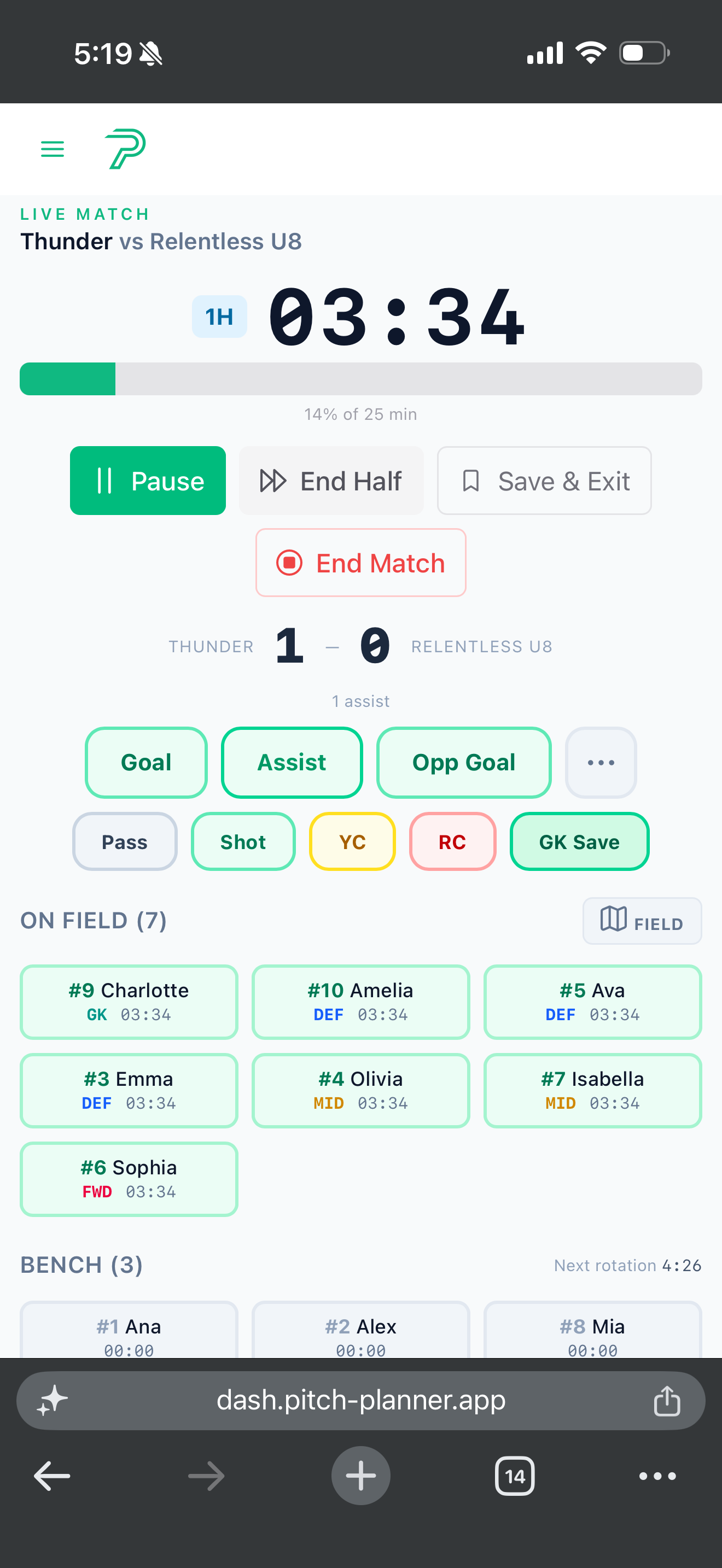
Free lineup, rotation, and playing-time tracking for youth soccer coaches. Set your team before kickoff, manage subs from your phone, and keep a clean match record after the whistle.